
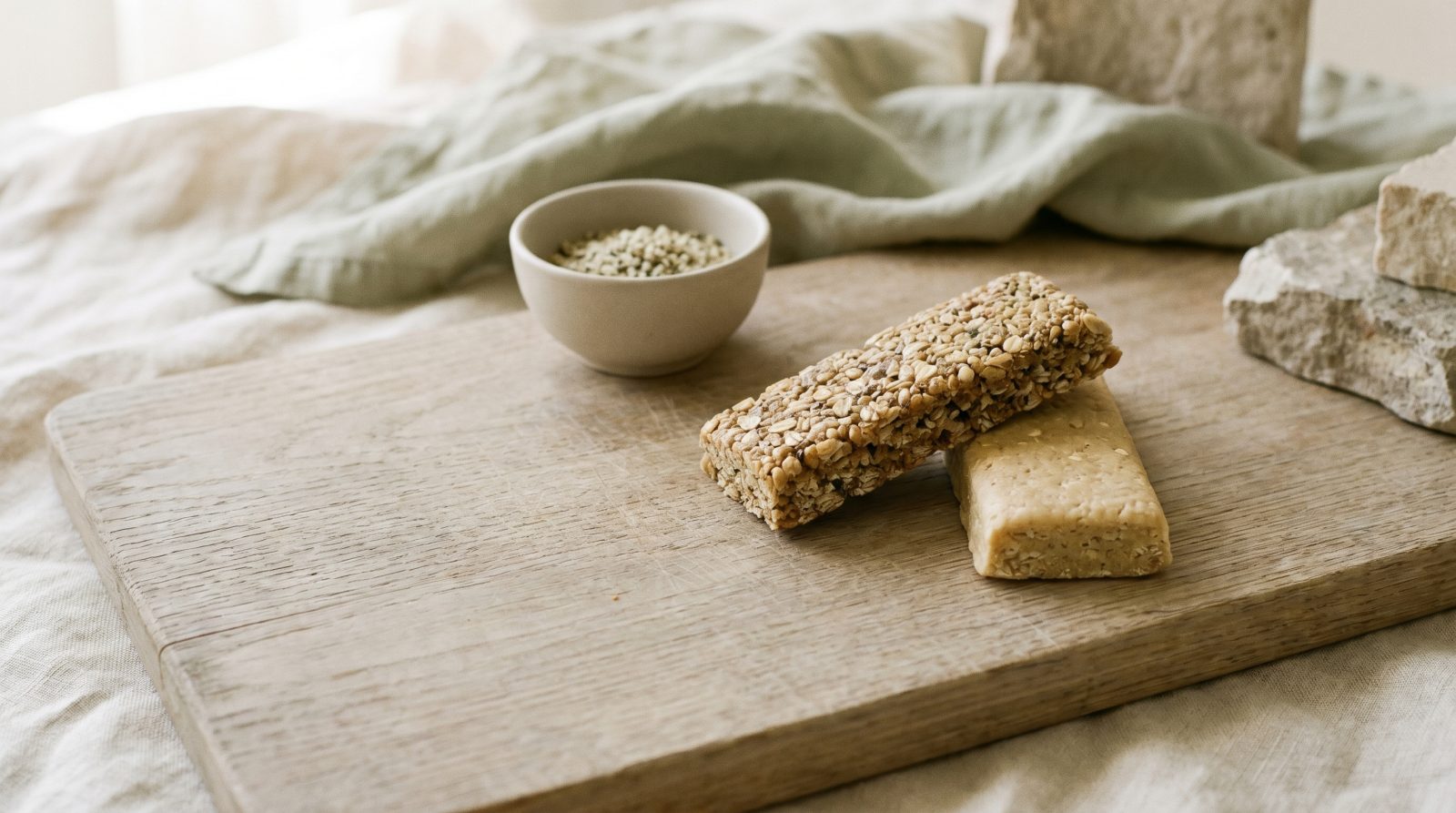
A side-by-side comparison of hemp protein bars against the four most common alternative protein bar types: whey, soy, pea, and meat (jerky/biltong) bars. The goal is to clarify when hemp is the right choice and when something else fits better.
Quick reference: 20 g protein bar comparison
| Bar type | Calories | Fibre (g) | Leucine (g) | Digestion speed | Allergen profile |
|---|---|---|---|---|---|
| Whey isolate | 200-240 | 2-5 | 2.2-2.5 | Fast | Dairy |
| Soy isolate | 200-240 | 3-5 | 1.8-2.0 | Medium | Soy (top-8 allergen) |
| Pea + rice | 210-260 | 3-7 | 1.6-1.9 | Medium | Low (some pea allergy) |
| Hemp + pea blend | 220-280 | 5-8 | 1.5-1.8 | Slow | Lowest mainstream |
| Hemp-only | 200-260 | 5-8 | 1.3-1.5 | Slowest | Lowest mainstream |
| Meat-based (jerky bar) | 120-180 | 0-2 | 1.8-2.5 | Medium-slow | None (meat allergens rare) |
When to choose hemp over whey
- You're lactose intolerant, dairy-sensitive, or vegan
- You want fibre with your protein
- You're prioritising the omega-3/GLA contribution
- You prefer a slower-absorbing protein (meal-replacement context)
- You want a Canadian-grown ingredient source
When to choose whey over hemp
- You're optimising for strength-training muscle protein synthesis
- You want the cheapest grams of protein per dollar
- You want the highest leucine per gram
- You need the fastest amino acid availability post-workout
Hemp vs soy
Soy protein has a higher PDCAAS and more leucine than hemp. The trade-off:
- Soy is a top-8 allergen; hemp is not
- Soy isolates are typically extracted with hexane (a petroleum solvent); hemp protein is mechanically pressed
- Soy has more documented hormonal concerns in animal studies (though human evidence is generally reassuring at normal dietary doses)
- Hemp contains GLA; soy does not
For dietary protein bars in everyday life, the differences are modest. For people specifically avoiding soy, hemp is a clean alternative.
Hemp vs pea
The two protein sources are similar in many ways: both plant-based, both moderate PDCAAS, both with fibre contributions. Differences:
- Pea is higher in leucine and lysine
- Hemp contains the full essential amino acid profile in roughly the same proportions found in human muscle; pea is more skewed
- Hemp provides omega-3 ALA and GLA; pea provides neither
- Pea has a chalky aftertaste many people dislike; hemp is nuttier and greener
- Pea is the better single-source choice for muscle-protein-synthesis specifically
This is why hemp-pea blends are increasingly common: each covers the other's weaknesses.
Hemp vs meat-based bars
Meat-based bars (jerky, biltong, pemmican-style) have re-emerged as a protein bar category. Differences from hemp:
- Meat bars are usually lower calorie at the same protein dose (less fat, no sweeteners)
- Meat protein is highly bioavailable and complete
- Meat bars are almost always low-carb, useful for ketogenic or carnivore eating styles
- Meat bars are dehydrated and shelf-stable for very long periods
- Hemp bars are plant-based and far lower environmental footprint per gram of protein
- Hemp bars are usually more palatable for sweet-leaning preferences
These categories serve different needs and many people benefit from rotating between them.
Cost per gram of protein in Canada (2026)
| Bar type | Typical price/bar | Protein/bar | $ per 10 g protein |
|---|---|---|---|
| Whey isolate | $3.00-4.50 | 20 g | $1.50-2.25 |
| Soy isolate | $2.50-4.00 | 15-20 g | $1.25-2.00 |
| Pea + rice | $3.00-4.50 | 12-15 g | $2.00-3.75 |
| Hemp blend | $3.50-5.50 | 12-18 g | $1.95-4.60 |
| Meat-based | $4.00-7.00 | 10-14 g | $2.85-7.00 |
Hemp sits in the upper-middle of the cost spectrum. Buying in bulk or via subscription typically reduces the cost gap with whey or soy bars.